The Momentum We Stopped Building
There's a pattern that's hard to ignore if you've been paying attention to Australian hip-hop and urban music over the past few years. Releases still arrive regularly, sometimes daily, but they land without weight. Artists drop projects into a void where nothing seems to connect to anything else. The biggest names in the scene release sporadically, often years apart, while unknown or emerging acts fill the gaps with material that rarely finds an audience beyond their immediate circle. What was once a scene defined by collective energy and cross-pollination now feels like a series of isolated attempts at relevance, each one competing for attention in an oversaturated landscape that has lost any sense of shared direction.
This isn't about talent. Australian artists remain technically skilled, ambitious, and hungry. The issue is structural and cultural: the scene has fragmented to the point where momentum, the kind that builds careers, shapes movements, and creates lasting cultural impact, has stalled. What replaced it is noise without curation, ambition without imagination, and survival tactics disguised as creative strategy.
Scenes don’t just live in sound. They live in rooms, moments, and the traces we choose to keep.
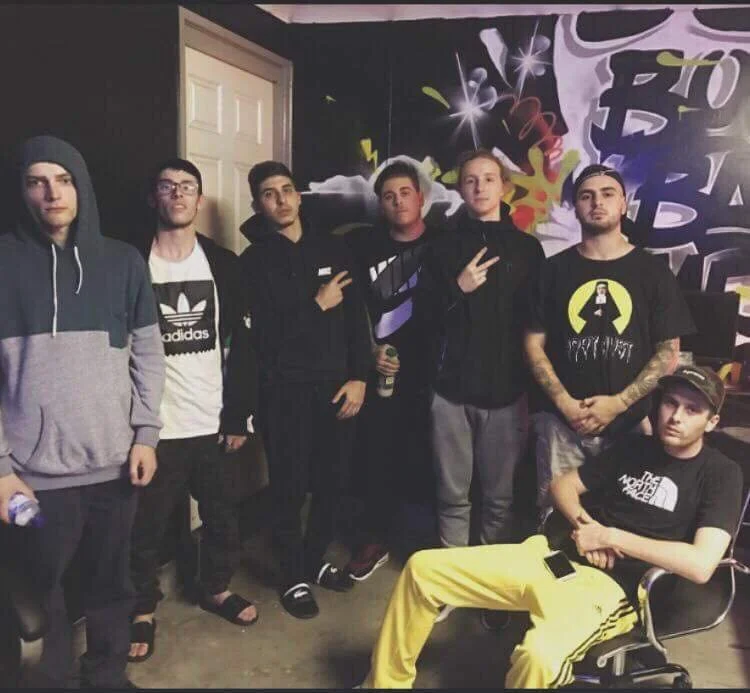
Chillinit x Talakai x Huskii x DH x Nerve x Wombat (2016 @ BodyBagMedia Studios)
Between roughly 2016 and 2020, Australian hip-hop operated differently. Artists released consistently, not just singles, but albums every few years that felt like events. Collaborations happened across cities and sound palettes, creating a sense of shared investment in the scene's growth. There was forward motion, not because everyone sounded the same, but because there was an implicit understanding that the scene's health depended on collective momentum. Artists built on each other's work. Features and joint projects weren't just promotional tools; they were statements of belief in a larger cultural project.
That cohesion has dissolved. Major Australian artists now exist in separate lanes with little crossover. Collaboration, once a defining feature of the scene, has become rare. When it does happen, it often feels transactional rather than driven by creative chemistry or shared vision. The result is a landscape where artists operate in silos, releasing material to their own audiences without contributing to a broader conversation. The connective tissue that once held the scene together, the sense that individual success fed into collective momentum, has frayed.
Part of what accelerated this fragmentation was the pursuit of global validation. As streaming platforms and social media created the illusion of borderless opportunity, Australian artists began chasing international trends rather than developing a distinctly local sound. The logic was understandable: if the goal is global reach, why anchor yourself to a regional identity that might limit your appeal? But in practice, this shift diluted what made Australian hip-hop compelling in the first place. The scene's strength was never in sounding like Atlanta or London; it was in creating something that reflected Australian realities, sensibilities, and creative instincts. When that specificity got traded for generic accessibility, the scene lost its most valuable asset, a clear sense of identity.
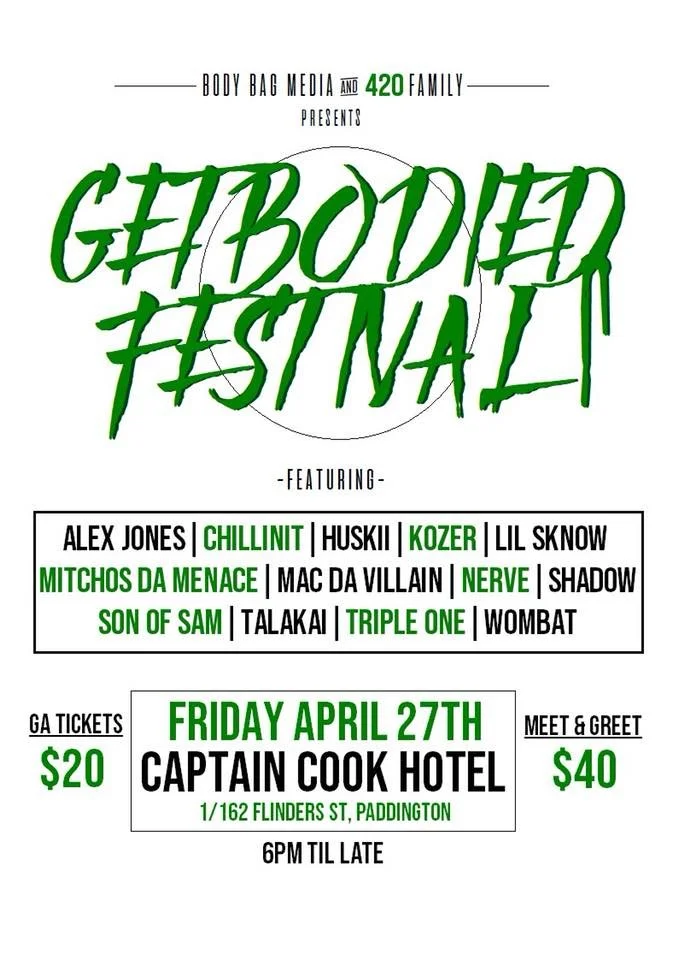
The event flyer from the “Get Bodied Festival” in 2018
The oversaturation problem compounded this. With barriers to entry lower than ever, releases have multiplied exponentially, but without editorial context or cultural leadership to shape how they're received. In the absence of trusted voices, whether media outlets, tastemakers, or even established artists, willing to curate and champion work, everything exists in a flat hierarchy where a major album release carries the same weight as a loosely assembled SoundCloud drop. This isn't democratisation; it's entropy. When everything is available and nothing is contextualised, belief in the scene itself erodes. Listeners don't know what to pay attention to, and artists don't know who they're building alongside.
Media shares responsibility here. Platforms that could have provided consistent documentation and context often chased immediacy over archive-building, or disappeared altogether when the work required sustained investment. The infrastructure that might have held the scene together, the publications and tastemakers who could champion work and connect dots between releases, was never built with enough durability to withstand the fragmentation.
What's missing most acutely is imagination. Not in the sense of individual creativity, plenty of Australian artists are making technically proficient, sonically ambitious music, but in the sense of collective vision. Imagination, in this context, means the ability to see beyond immediate survival, to invest in projects that might not pay off instantly but that contribute to the scene's long-term health. It means prioritising collaboration over competition, building institutions instead of relying on platforms, and accepting that cultural momentum requires patience and coordination.
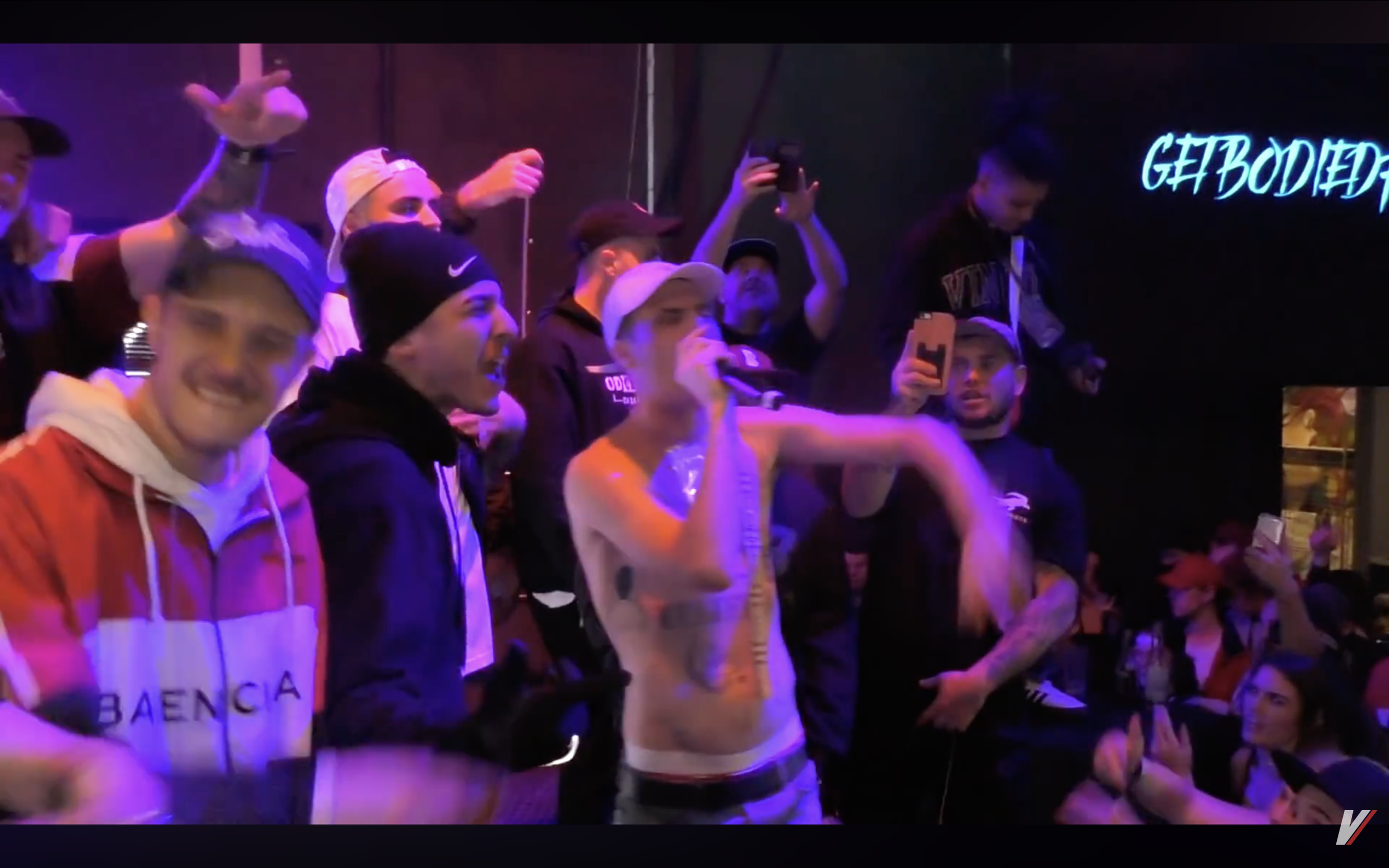
The absence of this kind of imagination is evident in how releases are approached. Albums, once treated as statements, are now often rushed or treated as content to satisfy algorithmic demand. Singles drop without context or follow-through. Projects are announced and then quietly shelved. The urgency that once drove the scene forward has been replaced by a reactive posture where artists respond to trends rather than setting them. This isn't a moral failing, it's a rational adaptation to an environment that rewards constant output over sustained vision. But the cost is steep: a scene that feels directionless, where individual hustle can't compensate for the lack of a shared project.
Australia's geographic and market realities make this fragmentation particularly damaging. The scene was never going to compete with larger markets on scale alone. Its strength was always in density, a concentrated, interconnected community where collaboration and mutual support created momentum that exceeded the sum of its parts. When that density dissolves, so does the scene's competitive advantage. Isolated artists working in separate lanes can't generate the cultural gravity needed to sustain belief, whether from audiences, media, or the industry itself.
The way forward isn't obvious, and it's not something that can be imposed from above. Momentum isn't built through strategic plans or industry initiatives; it's built through repeated acts of collaboration, curation, and creative risk-taking. It requires artists to see their work as part of a larger project rather than as individual bids for attention. It requires media and tastemakers to actively shape the conversation rather than passively document whatever surfaces. Most importantly, it requires belief, not in individual success, but in the possibility of a scene that's worth contributing to.
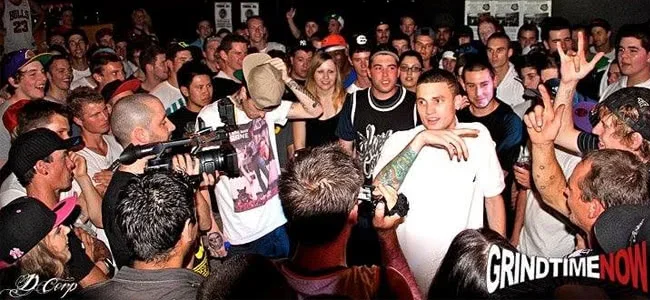
Iconic photo from the notorious 2012 “Kerser” vs “360” rap battle
That belief doesn't require returning to old sounds or structures. The future won't look like 2018, and it shouldn't. What's needed is shared intent, the understanding that individual work becomes more powerful when it exists within a context that's being actively built and maintained. Documentation matters. Context matters. The work of connecting releases, chronicling shifts, and championing what deserves attention is part of what creates the conditions for momentum to return.
That belief is fragile right now. The momentum that once seemed inevitable has stalled, and nothing has emerged to replace it. The question isn't whether Australian hip-hop can survive, it will. The question is whether the scene can rebuild the collective energy and shared imagination that once made it feel like something worth being part of. That won't happen by accident.